A psychologist doesn't lose clients because they're not good at their job. They lose them because, when someone searches for them on Google, they either can't be found, or find a site that looks like all the others.
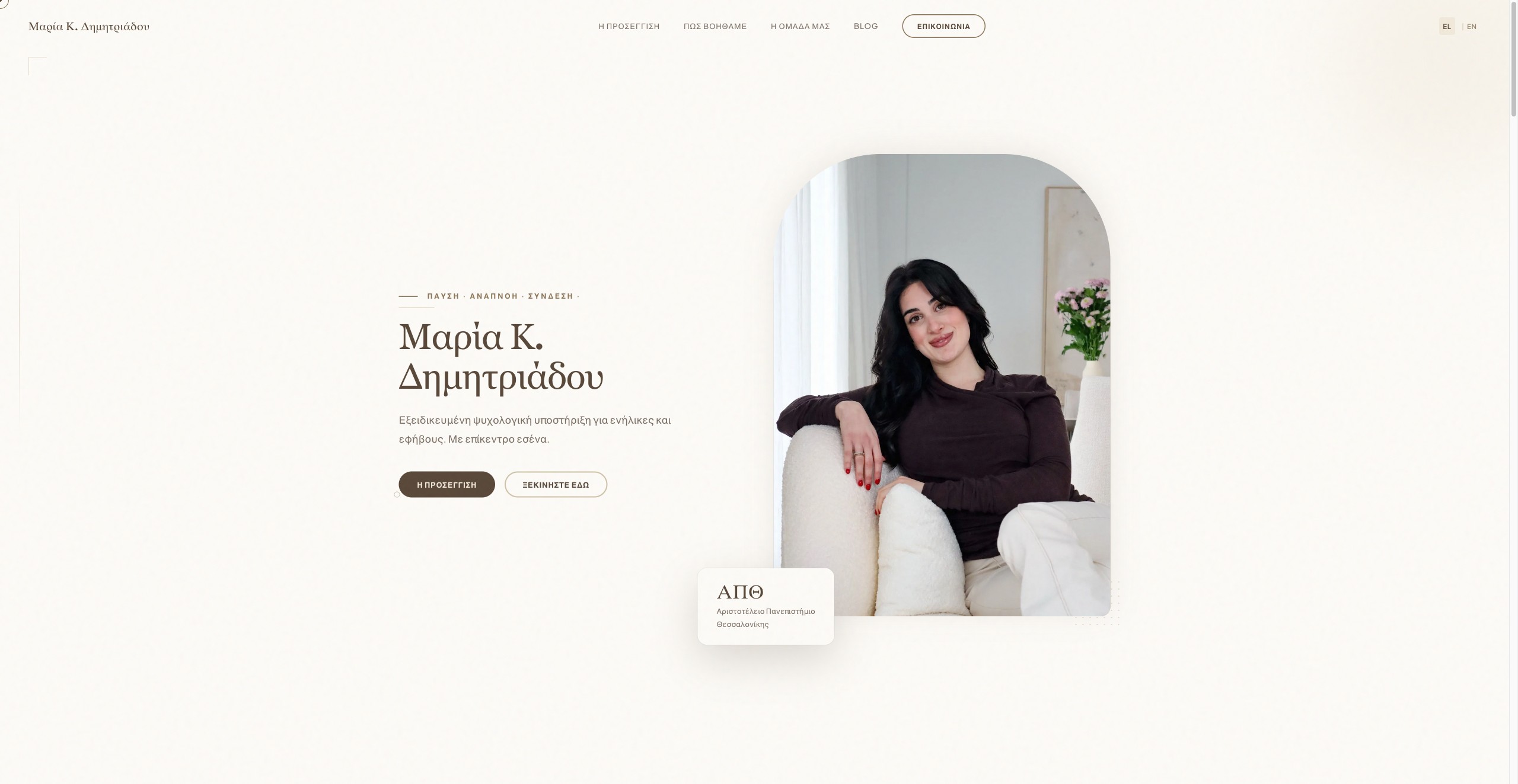
In this article I show a common problem that nearly all healthcare professionals have online, and a solution that works in practice. At the end, a real example: mariadimitriadou-psychologist.gr, with 148 organic visits a month from Google.
When someone decides to ask for help, they search on Google. If they can't find you there, or confuse you with ten identical profiles, they won't persist. They'll book with the next person who seemed trustworthy. The cost doesn't show up anywhere, but it's real.
The problem
Most professionals go online with generic templates that look like clinics or WordPress directories. Designs that all look the same, no connection to their identity and branding, poor SEO, zero bilingualism. Many, in the end, rely solely on Instagram.
- Sites that all look the same, with no personality or identity.
- Poor SEO, so no one finds them on Google.
- No bilingualism, meaning expats can't even read them.
Why it costs
Instagram is borrowed reach: you don't control it, it doesn't show up on Google, and it disappears in the scroll. When your presence depends only on that, every client who searched for you seriously and didn't find you is an appointment that went elsewhere. Over a month, that's a lot of appointments.
I didn't want a site like all the others. I wanted something that expressed me, and that people could find.
Maria, in our first conversation
The custom solution
A site built around her own identity, not around a ready-made theme. Her own colors, her own voice, a branding that shows her as she really is. Underneath, a structure built to rank on Google, with clean code and proper SEO from day one.
She also has her own blog, which she updates herself, without needing me each time. Every article is another door from Google leading to her.
Two real languages, not automatic translation
Thessaloniki has many expats looking for a therapist in English. So the site is fully bilingual: Greek as the primary language, English written properly, not run through an automatic translator. Every visitor reads in their own language and feels the site is speaking to them.

The proof: mariadimitriadou-psychologist.gr
The site is running live. In less than a month it brought 148 organic visits a month from Google, gathered 31 Google reviews at 5.0 (zero negative), and has full EL and EN bilingualism. Maria updates her own articles: 7 so far.
- 148 organic visits a month, from Google search.
- 31 reviews at 5.0, zero negative, in less than a month.
- 7 articles she publishes herself, without needing me.
What this means for you
If your presence depends only on Instagram, a site that represents you properly and ranks on Google brings you clients without you having to think about it. Your own identity, your own audience, your own data, and a door that's open 24 hours a day. If you'd like, tell me how you work and I'll tell you what I'd change.
FAQ
How do you build a bilingual website for a psychologist?
With language switching without a page reload, hreflang tags for SEO, and a separate URL structure (for example an /en/ prefix). Each language has its own SEO content, not a plain translation.
Does a psychologist need a website?
Yes, especially if they also serve English-speaking clients or want to appear on Google when someone searches for a psychologist in Thessaloniki. A website is the main visibility tool for a freelancer, unlike Instagram which you only rent.
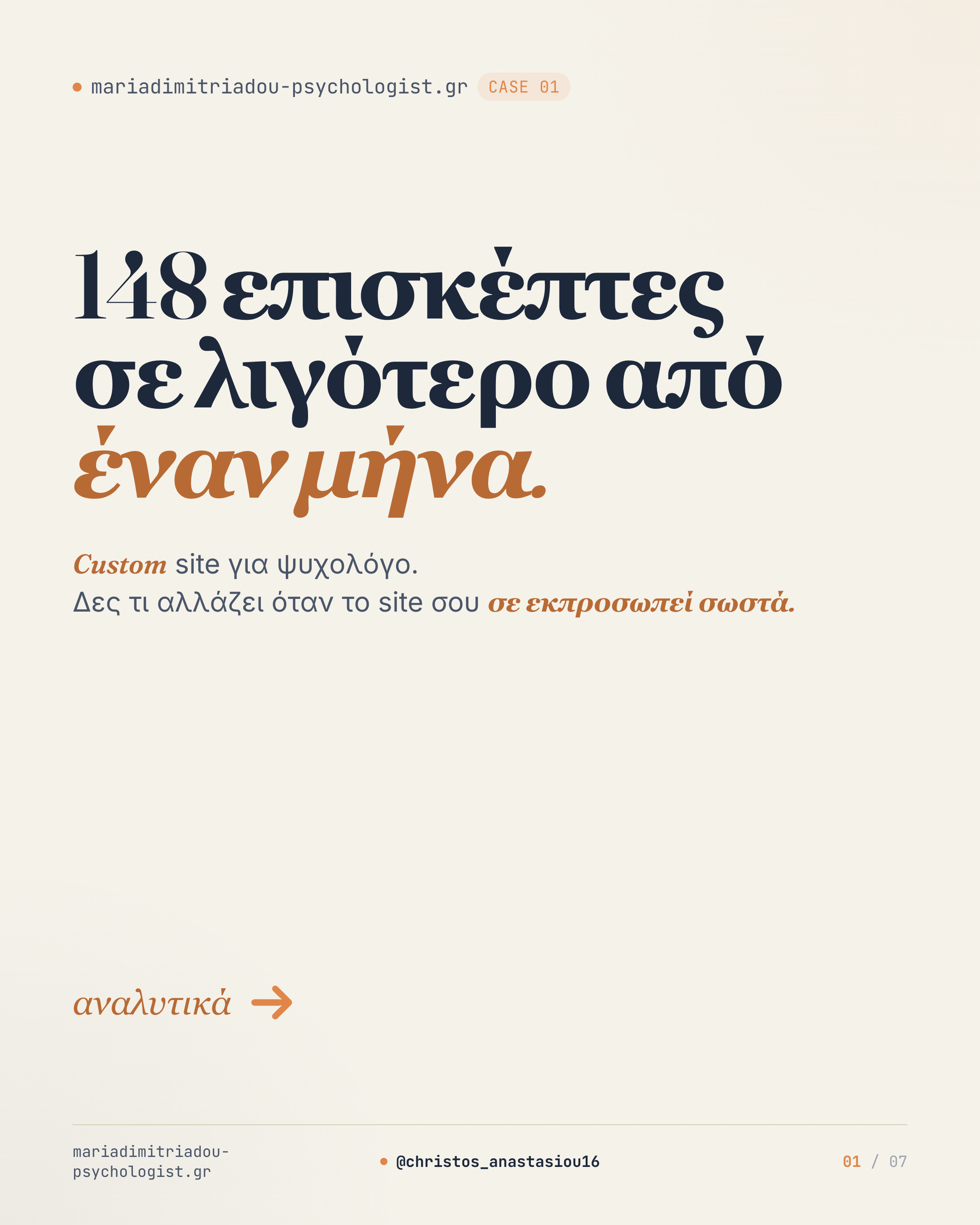
The live bilingual site and Maria's blog, as they work today.
See it live →Got an idea? Let's build it right, from scratch.
Write me a couple of lines about how you work. I reply personally.